.png)


.png)


Decoding API 9A & ISO 4309: Global Compliance in Wire Rope Manufacturing
May 29, 2026




HEBEI, CHINA — In heavy industrial lifting, maritime engineering, and offshore oil and gas exploration, steel wire ropes are the critical mechanical sinews holding high-value assets and human lives in the balance. As cranes venture into deeper waters and structural lifts breach historical tonnage limits, the compliance of wire rope manufacturing with international benchmarks is no longer a checklist—it is the foundation of operational survival.
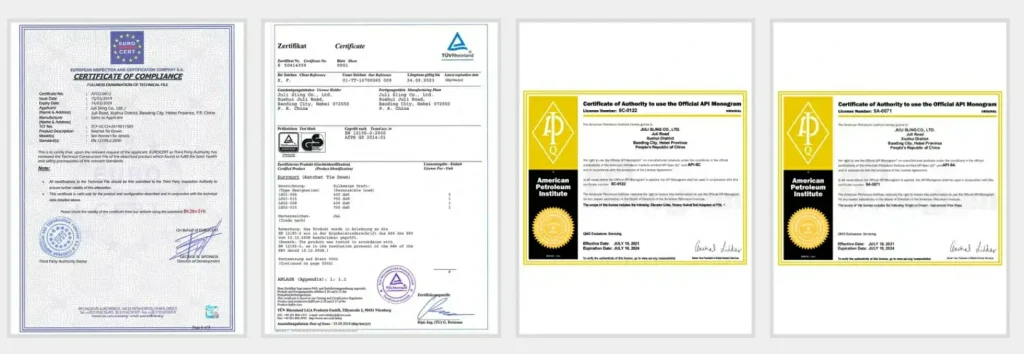
As a global pioneering force in the rigging and lifting industry, JULI SLING provides a deep technical decoding of the two primary pillars governing global wire rope excellence: API Spec 9A and ISO 4309. By aligning proprietary metallurgical engineering with these strict standards, JULI SLING continues to deliver factory-certified, zero-defect wire rope solutions to the world’s most demanding jobsites.
API Spec 9A: The Gold Standard for Offshore Oil & Gas Exploration
Developed by the American Petroleum Institute, API Spec 9A is the absolute regulatory mandate for wire ropes utilized in oil and gas drilling, well servicing, and offshore crane operations.
“API 9A does not merely measure breaking strength; it dictates the molecular and structural consistency of the steel wire from raw rod to completed strand,” notes JULI’s Chief Rigging Engineer.
Core Compliance Thresholds under API 9A Matched by JULI:
- Strict Metallurgical Chemistry: API 9A requires specialized high-carbon alloy steel rods with strictly limited sulfur and phosphorus thresholds to eliminate internal impurities and mitigate the risk of hydrogen embrittlement in sour-gas ($H_2S$) marine environments.
- Torsional and Bending Stress Resilience: Before stranding, individual wires undergo intense reverse-bend and torsion testing. JULI’s automated wire-drawing lines ensure that every micro-diameter strand achieves optimal ductility, preventing premature wire fatigue under high cyclic spooling.
- Precision Lubrication Barriers: Corrosion is the silent killer of offshore ropes. Compliant with API criteria, JULI applies advanced, temperature-stable structural compounds during the stranding process. This core-to-surface lubrication seals the rope against salt-spray ingress and reduces internal friction during multi-layer spooling on winch drums.
ISO 4309: The Definitive Blueprint for Field Inspection and Abandonment Criteria
While API 9A governs how a wire rope must be born, ISO 4309 governs how it lives, handles fatigue, and when it must be safely retired. For port authorities, shipyard managers, and heavy-lift directors, ISO 4309 is the universal operating manual for wire rope discard criteria.
JULI SLING integrates the framework of ISO 4309 directly into its product engineering, ensuring that customers can accurately predict the lifecycle ROI of their rigging assets through quantifiable metrics:
- Broken Wire Count Discard Thresholds: ISO 4309 outlines explicit formulas calculating the allowable number of visible broken wires over a length of 6d and 30d (where “d” is the nominal rope diameter). JULI’s computer-controlled weaving geometry ensures uniform force distribution, significantly delaying the onset of localized wire breakage.
- Diameter Reduction & Core Failure: A sudden decrease in rope diameter indicates internal core degradation or strand nesting. JULI utilizes high-density independent wire rope cores (IWRC) that maintain structural roundness and cross-sectional stability even under intense crushing forces experienced during multi-layer drum spooling.
- Non-Destructive Testing (NDT) Standardization: To facilitate compliance with ISO 4309 field inspections, JULI’s CNAS-certified laboratory utilizes Electromagnetic Non-Destructive Testing to baseline the internal integrity of custom rope runs before global export, providing clients with a perfect digital benchmark for future field assessments.
The JULI Advantage: Advanced Testing Infrastructure & Global Certification
At the heart of JULI SLING’s global compliance strategy is its world-class manufacturing complex, anchored by a CNAS-certified testing laboratory.
To guarantee that every high-tensile wire rope structure destined for international markets exceeds API 9A and ISO 4309 benchmarks, JULI deploys a comprehensive, multi-stage quality verification matrix:
- Full-Scale Destructive Tensile Testing: Utilizing ultra-high-capacity horizontal test beds, JULI conducts destructive break testing on full-scale rope samples to verify the actual Minimum Breaking Load (MBL) against calculated structural values.
- Microstructure and Metallographic Analysis: Optical and scanning microscopy inspects grain structures, heat-treatment depth, and galvanized zinc coating thickness to guarantee a flawless barrier against harsh industrial atmospheres.
- Third-Party Witness Audits: For critical maritime and offshore lifting projects, JULI regularly collaborates with major global classification societies—including DNV, ABS, Lloyd’s Register (LR), and SGS—to conduct witness testing, providing undisputed international validation.
Engineering the Future of Safe Lifting
As industrial projects scale up, the dependency on certified manufacturing escalates. Whether it is a 1,535-ton shipyard block lift or deep-water offshore crane deployment, JULI SLING’s unwavering adherence to API 9A and ISO 4309 ensures that every spool of wire rope leaving the factory floor represents the pinnacle of global safety engineering, high-tonnance capacity, and predictable operational longevity.
For technical consultations regarding custom wire rope specifications, structural design compliance, or to request a formal quote for bulk international distribution, please contact our global engineering support division.