


Mooring Line Breaking Strength: How to Calculate, Understand, and Choose the Right Mooring Rope
November 7, 2026




Mooring line breaking strength is one of the most important specifications when selecting ropes for commercial vessels, offshore platforms, LNG carriers, and marine engineering projects. However, choosing a mooring rope based only on its advertised breaking strength can create serious problems if the rope does not match the vessel’s mooring system, operating conditions, or onboard equipment.
A reliable mooring system requires more than a rope with a high tensile strength. Buyers and vessel operators must understand the relationship between Minimum Breaking Load (MBL), Line Design Break Force (LDBF), Working Load Limit (WLL), rope material, construction, and environmental loading.
At JULI Sling, we manufacture high-performance mooring ropes for marine and offshore applications. In this guide, we explain how to understand mooring line breaking strength, which factors affect rope performance, and how to select a suitable mooring line for your operation.
1. What Is Mooring Line Breaking Strength?
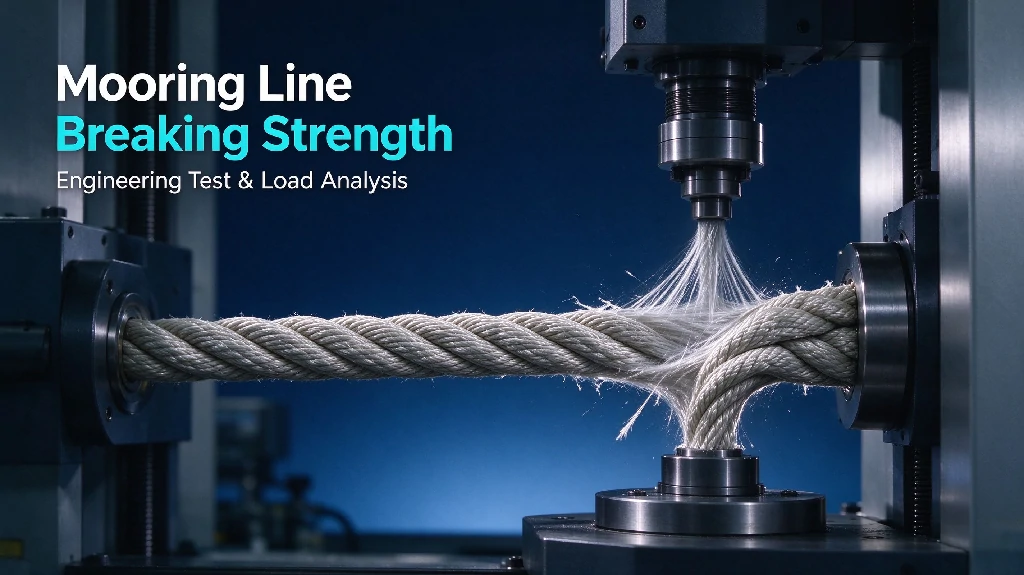
Mooring line breaking strength refers to the tensile force a mooring rope can withstand before it fails under a specified test condition.
Manufacturers evaluate rope strength through tensile testing, typically using a controlled pulling force until the rope reaches failure. The resulting value helps establish whether the rope meets the strength requirements of its intended application.
For marine procurement, several related terms deserve attention:
| Term | Meaning | Importance in Mooring |
| Breaking Strength | The force at which a rope specimen breaks during testing | Indicates the rope’s ultimate tensile performance |
| Minimum Breaking Load (MBL) | A specified minimum breaking-load value under defined conditions | Used in traditional specifications and ship design references |
| Ship Design MBL (MBLsd) | The reference breaking load for which a vessel’s mooring system is designed | Provides the basis for matching ropes and associated equipment |
| Line Design Break Force (LDBF) | The declared minimum breaking force of a new mooring line under the applicable test method | Used to specify and verify the performance of a mooring line |
| Working Load Limit (WLL) | The applicable operational load limit for a mooring line | Helps control loading during actual operations |
These terms are related, but they are not interchangeable.
Breaking Strength vs. Working Load Limit
One of the most common mistakes in mooring rope procurement is treating breaking strength as the load that a rope can safely carry during normal operation.
This is incorrect.
Breaking strength represents the rope’s resistance to failure under a specified test condition. Working Load Limit concerns the load permitted during service under the applicable design and operating requirements.
A rope should never be routinely loaded to its breaking strength.
For example, a mooring rope with a certified breaking force of 100 tonnes does not automatically have a WLL of 100 tonnes. Its permitted operating load depends on the applicable safety requirements, vessel design, mooring arrangement, environmental conditions, and manufacturer guidance.
Do not apply a generic safety factor to convert every rope’s breaking strength directly into an operational WLL. Marine mooring systems require application-specific engineering assessment.
2. Understanding MBL, LDBF, and MEG4 Requirements
For commercial shipping and offshore applications, understanding the terminology in OCIMF’s Mooring Equipment Guidelines, Fourth Edition (MEG4), is particularly important.
MEG4 introduced clearer terminology to reduce confusion between vessel design requirements and the actual tested performance of mooring lines.
Ship Design Minimum Breaking Load (MBLsd)
MBLsd refers to the design reference strength of the mooring lines for which a vessel’s mooring system is engineered.
It is established during vessel design based on factors such as:
- Vessel dimensions and displacement.
- Windage area and exposure to wind.
- Current and wave conditions.
- Mooring arrangement and line configuration.
- Design environmental criteria.
When replacing existing mooring ropes, buyers should first check the vessel’s approved mooring plan or mooring equipment documentation.
Selecting a rope simply because it has a higher advertised breaking strength does not necessarily improve safety. The replacement rope must remain compatible with the vessel’s original design and associated equipment.
Line Design Break Force (LDBF)
LDBF describes the minimum force at which a new, spliced mooring line will break when tested according to the applicable MEG4 procedure.
Under MEG4 guidance, the LDBF of a mooring line is generally specified at 100%–105% of the ship design MBL.
Mooring tails have separate requirements. Their Tail Design Break Force (TDBF) is generally specified at 125%–130% of the ship design MBL.
An important testing detail concerns nylon (polyamide) ropes. Because nylon absorbs water and its strength characteristics change when wet, its LDBF testing requirements specify a wet, spliced test condition.
These distinctions matter when preparing technical specifications, reviewing test reports, and comparing quotations from different mooring rope manufacturers.
Procurement recommendation: Always request the applicable test method, test condition, declared LDBF, rope construction, and supporting certificate. Comparing breaking strength figures without checking how they were obtained can lead to misleading purchasing decisions.
3. What Factors Affect Mooring Line Breaking Strength?
The breaking strength stated on a product datasheet is only one part of rope performance. Several manufacturing and operating factors determine whether a mooring line can maintain its required strength throughout its service life.
3.1 Rope Material
Different synthetic fibers have different tensile properties, elongation characteristics, water absorption rates, and resistance to environmental degradation.
For example:
- HMPE/UHMWPE provides an excellent strength-to-weight ratio and low elongation.
- Polyester offers good strength retention when wet, UV resistance, and abrasion resistance.
- Nylon provides high elasticity and helps absorb dynamic shock loads, although wet-condition strength must be considered.
- Polypropylene is lightweight and buoyant, making it suitable for applications where floating characteristics are important.
The material should match the intended mooring conditions rather than simply offering the highest initial breaking strength.
3.2 Rope Diameter and Linear Density
Rope diameter is an important purchasing parameter, but it cannot independently determine breaking strength.
Two ropes with the same nominal diameter may have different breaking loads because of differences in:
- Fiber type and tensile grade.
- Linear density and fiber content.
- Strand arrangement.
- Braiding or twisting technology.
- Manufacturing quality and construction efficiency.
When comparing mooring rope specifications, check the actual minimum breaking load rather than relying on diameter alone.
3.3 Rope Construction
The construction of a mooring rope affects how efficiently its fibers carry tension and how the rope behaves during handling and operation.
Common constructions include:
- 3-strand twisted rope: A traditional construction with straightforward handling and splicing characteristics.
- 8-strand plaited rope: A flexible, balanced construction widely used in marine mooring applications.
- 12-strand braided rope: A high-performance construction commonly used for demanding applications requiring a favorable strength-to-weight ratio.
The most suitable structure depends on the material, winch configuration, handling requirements, and intended application.
3.4 Splicing and Termination Efficiency
A mooring rope’s performance also depends on how its ends are prepared and connected.
An improperly executed splice can reduce the effective strength of the complete line. Knots, incorrect eye dimensions, poor splicing procedures, and unsuitable connections may create additional weak points.
For this reason, buyers should specify whether the required breaking strength refers to the rope body or the complete spliced assembly.
For critical applications, the test configuration should reflect the actual termination method and the applicable technical requirements.
3.5 Environmental Exposure and Service Conditions
A new rope’s breaking strength does not remain unchanged indefinitely.
Long-term exposure to environmental and operational factors can gradually reduce its residual strength:
- UV radiation can degrade susceptible synthetic fibers.
- Abrasion against fairleads, chocks, and deck fittings can damage load-bearing fibers.
- Repeated cyclic loading can contribute to fatigue.
- Chemical contamination and excessive heat may affect fiber performance.
- Shock loading can cause damage that is not immediately visible.
Regular inspection, appropriate protective measures, and documented rope management are essential for maintaining mooring system safety.
4. How Does Rope Material Affect Mooring Line Breaking Strength?
Material selection is a critical part of mooring rope specification. The strongest fiber on paper is not automatically the best choice for every vessel.
The following comparison highlights the main considerations when selecting synthetic mooring lines.
| Rope Material | Strength Characteristics | Elongation | Key Advantages | Typical Applications |
| HMPE / UHMWPE | Very high strength-to-weight ratio | Low | Lightweight, high strength, low stretch | Offshore mooring, deep-water applications, LNG vessels |
| Polyester | High tensile strength | Low to moderate | UV resistance, abrasion resistance, good wet-strength retention | Commercial shipping, long-term berthing |
| Nylon (Polyamide) | High tensile strength | High | Excellent elasticity and shock absorption | Dynamic mooring and towing applications |
| Polypropylene (PP) | Moderate strength depending on grade and construction | Moderate | Lightweight, buoyant, low water absorption | Floating lines and selected marine applications |
When Should You Choose HMPE or UHMWPE Mooring Rope?
HMPE and UHMWPE ropes are suitable when high breaking strength, reduced line weight, and low elongation are important requirements.
Their high strength-to-weight ratio makes them particularly attractive for offshore engineering, deep-water mooring, and large commercial vessels where handling efficiency is also important.
However, buyers should assess abrasion protection, bending performance, termination design, and the compatibility of the rope with existing winches and fittings.
Explore JULI’s PE Fiber Mooring Rope for high-strength floating mooring applications.
When Is Polyester Mooring Rope a Better Choice?
Polyester is a practical option for applications requiring a balance of tensile strength, abrasion resistance, UV stability, and dimensional stability.
It maintains its rated strength well in wet conditions and offers reliable performance in long-term marine environments.
For vessels operating in exposed ports or locations with frequent rope contact against deck fittings, polyester can provide a useful combination of durability and service performance.
Explore JULI’s Polyester Mooring Rope for heavy-duty berthing and marine applications.
When Should You Consider Nylon Mooring Rope?
Nylon is known for its high elasticity, which allows it to absorb energy generated by vessel movement, wave action, and sudden changes in line tension.
This characteristic can be useful in dynamic mooring and towing applications.
However, nylon’s elongation also means that it can store considerable elastic energy. Buyers must consider snap-back hazards, wet-condition strength, and the vessel’s mooring arrangement when specifying nylon ropes.
Is Polypropylene Suitable for High-Strength Mooring Applications?
Polypropylene is lightweight and floats on water, which makes it convenient for certain marine operations.
Nevertheless, its strength, heat resistance, and long-term UV performance must be evaluated carefully. It should not be selected solely because it is easy to handle or economical.
The appropriate fiber grade and rope construction must meet the actual design load and service requirements.
5. How to Select the Right Mooring Line Breaking Strength
Selecting the correct mooring line is a technical process. Buyers should follow a structured approach rather than choosing the largest breaking strength available.
Step 1: Confirm the Vessel’s Design Requirements
Start with the vessel’s approved mooring plan, equipment specifications, or existing mooring line certificates.
Identify:
- Ship Design MBL.
- Required LDBF and applicable testing conditions.
- Required tail specifications, where applicable.
- Number and arrangement of mooring lines.
- Existing winch and deck fitting limitations.
For vessels designed under MEG4, use the specified ship design MBL as the primary reference for replacement line selection.
Step 2: Evaluate the Actual Mooring Environment
The required rope performance depends on where and how the vessel operates.
Consider:
- Maximum expected wind speed and current conditions.
- Wave action and tidal variations.
- Berth exposure and water depth.
- Frequency of berthing and unberthing.
- Offshore or nearshore operating conditions.
- Potential contact with abrasive surfaces.
For example, a rope used at a sheltered commercial port may have different durability and elongation requirements from one used in exposed offshore operations.
Step 3: Select the Appropriate Material and Construction
After confirming the required breaking force, choose the fiber and construction that provide the best overall performance.
For example:
- Choose HMPE/UHMWPE when strength-to-weight ratio and low elongation are priorities.
- Choose polyester when abrasion resistance, UV stability, and wet-strength retention are important.
- Consider nylon when controlled elasticity and shock absorption are required.
- Consider polypropylene when buoyancy and lightweight handling are important.
The material and construction must also be compatible with the vessel’s operational equipment.
Step 4: Check Winch and Mooring Hardware Compatibility
A stronger replacement rope does not automatically create a safer mooring system.
Check the compatibility of the rope with:
- Mooring winches and brake settings.
- Fairleads and chocks.
- Bollards and bitts.
- Shackles and connecting hardware.
- Rope diameter and drum capacity.
- Spliced eye dimensions and connection arrangements.
All components must be assessed as part of the complete mooring system.
Step 5: Verify Certificates and Test Reports
Before confirming a purchase, request the relevant documentation.
A professional mooring rope specification should identify:
| Documentation | What Buyers Should Verify |
| Product Datasheet | Material, diameter, construction, linear density, and nominal specifications |
| Breaking Load Test Report | Tested breaking force and applicable test conditions |
| Product Certificate | Declared performance and traceability |
| DNV / Classification Documentation | Product-specific approval or certification scope, where required |
| Splicing Information | Termination method and relevant assembly specifications |
For projects requiring compliance with OCIMF MEG4, ensure that the manufacturer can provide the documentation applicable to the specified rope design and certification scope.
6. Why Mooring Rope Breaking Strength Is Not the Only Safety Indicator
A rope with a high initial breaking load may still be unsuitable if it has poor abrasion resistance, excessive elongation for the application, or inadequate compatibility with the vessel’s mooring equipment.
Three additional considerations deserve attention.
Residual Strength: A used rope may have significantly lower strength than its original certified value. Inspection records and condition monitoring help identify degradation before it becomes critical.
Dynamic Loading: Vessel movement, waves, tides, and sudden tension changes can produce loads that differ substantially from static design assumptions. Rope elasticity and fatigue resistance must therefore be considered alongside breaking strength.
System Compatibility: Winches, fittings, tails, and ropes must work together within the vessel’s approved design limits. Replacing a line with a stronger model without reviewing brake settings and associated hardware can introduce new risks.
For this reason, we recommend evaluating mooring ropes through their complete service requirements rather than comparing isolated breaking load figures.
7. JULI Sling: High-Performance Mooring Ropes for Marine and Offshore Applications
At JULI Sling, we provide mooring rope solutions for commercial vessels, offshore engineering, LNG transportation, and demanding marine operations.
Our product range covers different fiber materials and rope constructions, allowing buyers to match strength, weight, elongation, and durability requirements with their intended applications.
Multiple Fiber Options for Different Strength Requirements
We manufacture mooring ropes using a range of synthetic fibers, including:
- HMPE and UHMWPE for high-strength, lightweight applications.
- Polyester for durable marine mooring.
- Nylon for applications requiring elasticity and shock absorption.
- Polypropylene for buoyant and lightweight rope requirements.
- Specialized fiber combinations for selected marine engineering applications.
8-Strand and 12-Strand Mooring Rope Solutions
JULI supplies different rope constructions to meet diverse handling and performance requirements.
Our 8-strand and 12-strand mooring rope solutions support commercial shipping, heavy-duty berthing, offshore engineering, and other demanding applications.
We also offer different rope diameters and configurations to match project specifications.
DNV-MEG4 Base Design Certification for High-Performance Mooring Lines
JULI Sling has successfully obtained DNV Mooring Line Base Design Certification for five high-performance fiber mooring line types in accordance with OCIMF MEG4.
The certified product range covers:
- UHMWPE mooring main lines.
- Polyester/polyolefin mooring main lines.
- Polypropylene mooring main lines.
- Polyamide mooring tail lines.
- Polyester/polyolefin mooring tail lines.
This achievement reflects our capabilities in fiber selection, rope structural design, manufacturing process control, and mechanical performance validation.
For projects requiring certified marine rope solutions, buyers can review the relevant product certification and technical documentation with our team.
Read more: JULI Sling Achieves DNV-MEG4 Mooring Line Certification.
Customized Mooring Rope Manufacturing
Different vessels and offshore projects require different rope specifications. We support customized requirements involving:
- Rope material and fiber combinations.
- Diameter and minimum breaking load.
- 3-strand, 6-strand, 8-strand, and 12-strand constructions.
- Rope length and customized packaging.
- Eye splicing and termination configurations.
- Product testing and applicable certification documentation.
By understanding your vessel’s design requirements and operating environment, we can help identify a suitable mooring rope configuration for your project.
Explore our complete Mooring Rope Product Range or contact our team for technical assistance.
8. Frequently Asked Questions About Mooring Line Breaking Strength
Q1: What is a good breaking strength for a mooring line?
There is no universal breaking strength suitable for every vessel. The required value depends on the vessel’s Ship Design MBL, mooring arrangement, environmental conditions, and applicable technical requirements.
For commercial vessels, always check the approved mooring plan before specifying replacement lines.
Q2: Is breaking strength the same as MBL?
Not exactly. Breaking strength is a general description of the force at which a rope breaks under specified test conditions. MBL is a defined minimum breaking-load specification. In MEG4 terminology, Ship Design MBL and Line Design Break Force have distinct roles.
Q3: What is the difference between MBL and LDBF?
Ship Design MBL is the reference strength used for the vessel’s mooring system design. LDBF is the declared minimum breaking force of a new mooring line under the applicable MEG4 test procedure.
For MEG4 applications, the LDBF of a mooring line is generally specified at 100%–105% of the ship design MBL.
Q4: Does a larger rope diameter always mean higher breaking strength?
No. Breaking strength also depends on fiber material, linear density, rope construction, and manufacturing quality. Buyers should compare certified breaking load values rather than diameter alone.
Q5: Which mooring rope material has the highest breaking strength?
HMPE and UHMWPE fibers offer exceptionally high strength-to-weight ratios. However, the most suitable material depends on the required diameter, elongation, abrasion resistance, operating conditions, and equipment compatibility.
Q6: Does water affect mooring rope breaking strength?
Yes, depending on the fiber material. Nylon absorbs water and its strength characteristics change when wet. Polyester generally maintains its rated strength when wet, while HMPE and polypropylene have very low water absorption.
For MEG4-related nylon line specifications, the wet test condition is particularly important.
Q7: How often should mooring ropes be inspected?
Inspection frequency should follow the vessel’s Mooring System Management Plan, rope manufacturer’s instructions, applicable regulations, and actual service conditions.
Ropes should also be checked after abnormal loading events, visible damage, or suspected exposure to harmful conditions.
Q8: Can JULI Sling manufacture mooring ropes with customized breaking strength?
Yes. JULI Sling provides customized mooring rope solutions based on material, diameter, construction, length, and project-specific requirements. Buyers can share their required breaking load, vessel information, and applicable certification requirements for technical evaluation.
Choose the Right Mooring Rope with JULI Sling
Selecting a mooring line is not simply about finding the rope with the highest breaking strength. It is about matching the rope’s certified performance with the vessel’s design requirements, operating environment, and complete mooring system.
With a broad selection of synthetic fiber materials, 8-strand and 12-strand constructions, and DNV-MEG4 certified high-performance mooring line designs, JULI Sling supports marine and offshore customers with reliable, application-oriented rope solutions.
Looking for a mooring rope with a specific breaking strength or certification requirement? Contact JULI Sling with your technical specifications. Our team can help you evaluate the right material, construction, and configuration for your project.