


Meeting IMO Standards in Offshore Wind: How HMPE Ropes Transform Marine Heavy-Lift Operations
October 17, 2026




As the global clean energy transition accelerates, the offshore wind and marine engineering sectors are undergoing an unprecedented technological evolution. To meet stringent safety standards established by the International Maritime Organization (IMO) and handle the escalating scale of offshore infrastructure, industry leaders are rapidly retiring traditional steel wire ropes in favor of Ultra-High Molecular Weight Polyethylene (UHMWPE / HMPE) ropes.
Juli Sling Co., Ltd., a recognized industry leader and national standard-setter in lifting and rigging equipment, is at the forefront of this shift. Through its engineered High-Strength UHMWPE Ropes, Juli Sling provides marine contractors, offshore installation companies, and naval operators with lightweight, high-tenacity rigging solutions designed to optimize operational efficiency and maximize environmental compliance.
The Offshore Wind Paradigm Shift: Bigger Turbines, Tougher Conditions
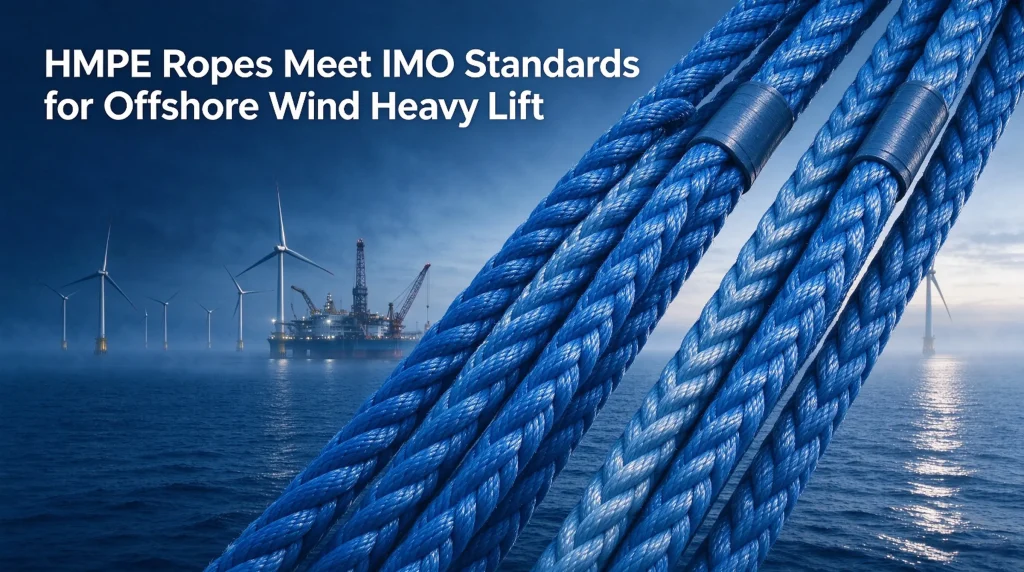
The global offshore wind power industry has transitioned into an era of giant turbines. Next-generation offshore installations feature capacities exceeding 15 MW to 20 MW, with blade lengths spanning over 100 meters and nacelle weights topping hundreds of metric tons. Deploying these colossal structures into deeper oceanic waters demands rigging equipment that offers maximum tensile strength without adding excessive deadweight to crane booms and installation vessels.
Historically, steel wire ropes served as the default choice for heavy-lift rigging, towing, and deepwater mooring. However, as lifting capacities scale up, the intrinsic limitations of heavy steel wire ropes become major operational bottlenecks:
- Extreme Self-Weight: Thick steel wire ropes add massive deadweight to lifting gear, reducing the net lifting capacity of floating installation vessels (FIVs) and jack-up rigs.
- Corrosion & Degradation: Continuous exposure to saltwater, salt fog, and harsh marine environments accelerates steel oxidation, necessitating frequent, costly lubrications and premature retirements.
- Severe Physical Hazards: Heavy steel wire ropes require large crews to manually handle, leading to increased risk of back injuries, pinches, and catastrophic “snap-back” hazards if a line parts under tension.
To overcome these challenges, marine engineering companies are swiftly embracing Ultra-High Molecular Weight Polyethylene (UHMWPE/HMPE) technology.
IMO Regulatory Framework & The Drive for Sustainable Marine Rigging
The transition toward HMPE synthetics is not purely driven by mechanical performance; it is also strongly accelerated by global maritime regulatory mandates.
The International Maritime Organization (IMO) has continually tightened regulations regarding vessel safety, environmental compliance, and carbon emission reductions across international waters. Key regulatory drivers include:
- IMO SOLAS MSC.1/Circ.1620 (Safe Mooring Operations): Enhanced guidelines regarding mooring line design, inspection, and maintenance place higher demands on line fatigue life, weight management, and ergonomic safety for maritime crew members.
- Decarbonization and Carbon Intensity Indicator (CII): Reducing shipboard weight directly translates to lower fuel consumption during transit and installation operations. Replacing metric tons of steel wire with lightweight UHMWPE lines directly supports offshore fleets in reaching their decarbonization targets.
- Zero Marine Contamination: Traditional steel wire ropes rely heavily on chemical greases and asphaltic lubricants to prevent rust. In marine environments, these lubricants leach into the ocean, contributing to marine pollution. In contrast, UHMWPE ropes require zero environmental-toxic greases, complying fully with stringent zero-discharge ocean conservation policies.
The Technology Behind UHMWPE: Why Synthetic Outperforms Steel
Ultra-High Molecular Weight Polyethylene (UHMWPE) represents the pinnacle of modern synthetic fiber engineering. By aligning extremely long molecular chains, manufacturers yield a fiber with exceptional mechanical properties.
Key Advantages of UHMWPE Ropes over Steel Wire:
- Superior Strength-to-Weight Ratio: HMPE fiber exhibits a tensile strength up to 15 times greater than high-grade steel on a weight-for-weight basis. An HMPE rope capable of matching the break load of a steel rope weighs roughly 1/7th to 1/8th of its steel counterpart.
- Positive Buoyancy: Unlike steel, which sinks rapidly, UHMWPE ropes have a specific gravity of approximately 0.97 to 0.98, allowing them to float on water. This dramatically simplifies deepwater recovery, marine rigging setup, and towing operations.
- Reduced Snap-Back Risk: HMPE fibers store significantly less elastic energy under tension than steel wire. In the rare event of a line failure, UHMWPE ropes exhibit minimal recoil, drastically lowering the risk of fatal injuries or equipment destruction.
- Chemical and UV Resistance: High-grade UHMWPE fibers display outstanding resistance to marine bio-fouling, harsh acids, alkalis, organic solvents, and intense solar UV radiation, guaranteeing extended operational lifespans in ocean climates.
Spotlight on Innovation: Juli Sling’s High-Strength UHMWPE 8-Strand & 12-Strand Ropes
Engineered specifically to solve complex marine lifting, mooring, and towing challenges, Juli Sling offers advanced synthetic solutions tailored for global EPC contractors and vessel operators.
For technical details and custom specifications, visit the official product portal:
| PROPERTY | TRADITIONAL STEEL WIRE ROPE | JULI UHMWPE SYNTHETIC ROPE |
| Weight Comparison | 100% (Extremely Heavy) | 12% – 15% (Ultra-Lightweight) |
| Buoyancy in Water | Sinks (SG ~ 7.85) | Floats (SG ~ 0.97 – 0.98) |
| Grease / Lubrication | Required (Marine Pollutant) | None Required (Eco-Friendly) |
| Corrosion Resistance | Susceptible to Rust | 100% Corrosion Proof |
| Handling Crew Needed | Large Deck Crew + Winches | Minimal Crew (Hand-Handleable) |
| Snap-Back Risk | High Energy (Catastrophic) | Low Energy Recoil (Safer) |
Core Architectural Features:
- 12-Strand Torque-Neutral Braiding: Designed with a 12-strand torque-free balance structure, preventing internal twisting, hockling, or bird-caging under extreme loads. Ideal for crane hoist lines, heavy-lift grommets, and deepwater winch systems.
- 8-Strand Balanced Construction: Engineered for robust marine towing, ship-to-ship transfers, and primary mooring systems where abrasion resistance and flexibility are paramount.
- Specialized Polyurethane Coating: Each strand is pre-treated with a proprietary protective coating that minimizes inter-fiber friction, seals against micro-sand ingress, and enhances outer abrasion resistance against fairleads and bollards.
- Custom End-Terminations & Sleeves: Supplied with engineered spliced eyes, thimbles, heavy-duty protective sleeves, and anti-friction jackets customized to meet international lifting standards (including ASME B30.9 and EN specifications).
Field Applications in Offshore Engineering
Juli Sling’s UHMWPE synthetic lines are engineered for high-consequence marine environments:
- Offshore Wind Blade & Nacelle Installation: Used as auxiliary tag lines, main lifting grommets, and spreader bar slings. Their lightweight, non-marring surface prevents cosmetic or structural damage to expensive composite turbine blades during crane maneuvers.
- Deepwater Anchor & Mooring Lines: Serving as permanent or temporary mooring lines for floating offshore wind platforms, FPSOs, and drillships, providing fatigue resistance over years of wave action.
- Heavy-Lift Spreader Rigging: Replacing massive steel cable slings in jacket foundation installation, subsea manifold placement, and monopile positioning.
- Ocean Towing & Salvage: Providing high-tenacity, floatable towlines for emergency marine rescue and long-distance barge towing.
About Juli Sling Co., Ltd.
Since its establishment, Juli Sling has redefined excellence as a China leader supplier of lifting and rigging equipment, delivering lifting slings, wire rope slings, ratchet straps, mooring ropes, shackle, chain, hook&ring, elevator link and lifting beam to industries where safety and reliability are critical—energy, infrastructure, defense, and maritime engineering.
As a qualified and entrusted manufacturer in the rigging industry and China’s national & industry standard-setter, we provide customized solutions for iconic projects in heavy-lift sectors such as Oil&Gas, wind power, construction machinery, port construction, offshore engineering, deepsea mooring, mining, etc., combining innovation, compliance, and unmatched technical rigor across our comprehensive product range.
Conclusion & Contact Information
The shift from steel wire rope to high-performance UHMWPE synthetic lines is no longer a future concept—it is today’s operational standard for marine contractors striving to comply with IMO guidelines and reduce offshore project risk.
Contact Juli Sling to upgrade your offshore fleet with certified, high-efficiency synthetic rigging.