.png)


.png)


Shackle vs. Clevis: What Is the Difference for Lifting Applications?
October 1, 2026




A shackle and a clevis may look almost identical, but they serve different engineering purposes. A shackle is a dedicated connection component for rigging and lifting systems, while a clevis usually forms part of a mechanical assembly or provides a pivot connection. The difference becomes important when a connector must carry a suspended load. A heavy duty shackle normally has a defined Working Load Limit (WLL), identification markings, and a design intended for rigging service. A general-purpose clevis may have a strong steel body, but that does not make it suitable for overhead lifting.
For B2B buyers, the distinction goes beyond shape. Load direction, connection geometry, working load, pin design, material, manufacturing process, inspection, and applicable standards all affect the selection. A shackle may connect a sling to a lifting lug, while a clevis may connect a hydraulic cylinder to a machine frame. Both connections use a removable pin, yet their load paths can be very different.
Consider a crane lifting a 10-tonne machine module. The rigging team needs a connector between the sling and the lifting lug. A rated shackle provides a defined lifting connection. A general clevis from a machinery supplier may not have a lifting rating or the required documentation. Using the second component simply because its dimensions look suitable creates an engineering gap.
This article explains the practical difference between a shackle and a clevis. It also examines how professional buyers can evaluate each component before specifying it for lifting equipment, machinery, construction, marine, or industrial applications.
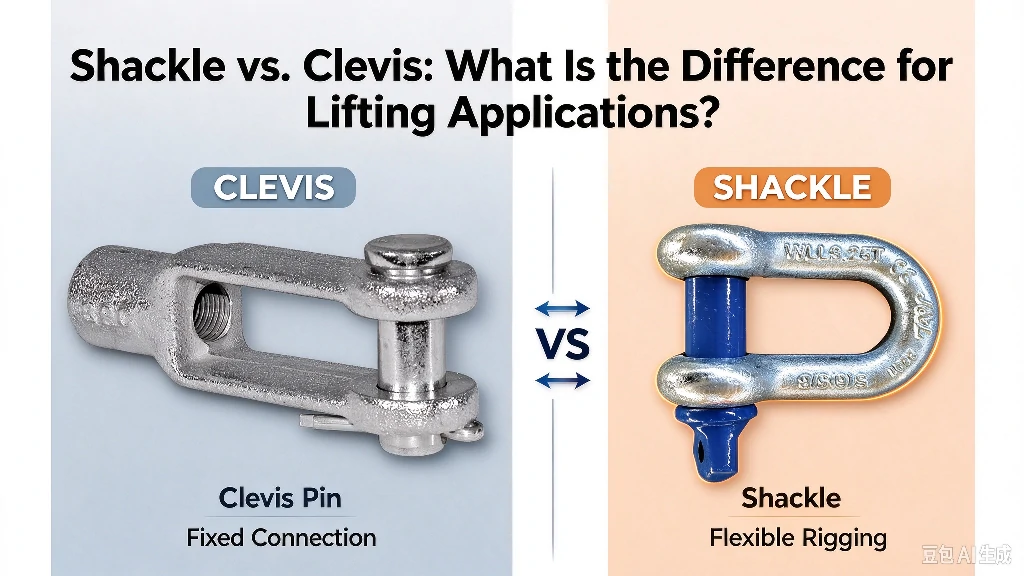
What Is the Basic Difference Between a Shackle and a Clevis?
The easiest way to separate the two is to look at their intended function.
A shackle works as a detachable rigging connector. It commonly links slings, chains, lifting lugs, master links, hooks, and other rigging components. The body forms a U-shaped or bow-shaped connection, while a removable pin closes the load path.
A clevis normally works as part of a mechanical connection. It often consists of two parallel ears with a hole through each ear. A clevis pin passes through those holes and connects another component between the ears.
The visual similarity creates confusion because both products can use a U-shaped body and removable pin. Their engineering requirements can still differ substantially.
Shackle Design and Function
A lifting shackle carries a load through its body and pin. The load transfers from one connected component through the pin and into the shackle body.
Common shackle configurations include:
- Bow or anchor shackles
- Dee or D shackles
- Screw pin shackles
- Bolt-type shackles
- Safety bolt shackles
- Alloy steel lifting shackles
The correct type depends on the load direction, connection geometry, operating environment, and required WLL.
ASME B30.26 covers detachable rigging hardware used for load handling. Its scope includes shackles along with links, rings, swivels, turnbuckles, eyebolts, hoist rings, wire rope clips, and other rigging hardware.
Clevis Design and Function
A clevis usually provides a pinned joint between two mechanical components.
For example, a hydraulic cylinder may use a clevis end to connect with a machine frame. A trailer component may use a clevis connection to allow controlled movement around a pin. Agricultural equipment and industrial machinery also use clevis-style connections.
The clevis normally expects the connected parts to move around the pin.
That pivoting function is central to many clevis applications. The component’s suitability depends on its intended mechanical assembly rather than its visual similarity to lifting hardware.
Why the Terminology Matters
In everyday industrial language, people sometimes use “clevis” as a broad term for fork-shaped connectors.
That creates an important procurement risk.
A clevis-style component can look physically strong while lacking a documented WLL. It may also lack lifting-specific markings, proof testing, or design information for overhead load handling.
For this reason, buyers should specify the application rather than ordering only by shape.
How Do Shackles and Clevises Differ in Load Handling?
The most important engineering difference appears when the connector enters a lifting system.
A shackle normally transfers load between rigging components. Its design considers the forces generated by suspended loads and the connection geometry used in lifting.
A clevis transfers force between mechanical components. Its loading may involve tension, shear, bending, or a combination of forces within a machine assembly.
These load conditions can overlap, but the design basis does not automatically match.
Load Path Through a Shackle
Imagine a wire rope sling connected to a lifting lug.
The sling eye enters the shackle body. The shackle pin passes through the sling eye and lifting lug. When the crane lifts the load, the force travels through the pin and into the shackle body.
The load path can be simplified as:
Crane → sling → shackle pin → shackle body → lifting lug → load
The shackle therefore becomes a defined part of the rigging system.
Its WLL must match the intended loading configuration. The connected sling and lifting lug must also have suitable capacity.
Load Path Through a Clevis
A clevis connection often looks different.
Consider a hydraulic cylinder connected to a moving arm. The cylinder has a clevis end with two ears. A pin passes through the ears and the mating component.
The force transfers through the pin and clevis ears as the mechanism moves.
The connection may experience repeated cycles and changing load directions. The engineering focus may therefore include bearing stress, shear, fatigue, pin wear, and joint movement.
That does not make the clevis weak. It simply means the component serves a different design purpose.
Why Tensile Strength Does Not Equal Lifting Capacity
A common purchasing mistake is comparing material strength or ultimate tensile strength.
Suppose a clevis is made from high-strength alloy steel. Its material may withstand substantial force under a specific test condition.
That information alone does not establish a safe lifting capacity.
A lifting connector needs a defined rating for its intended configuration. The rating must also account for geometry, loading direction, manufacturing controls, inspection, and applicable design requirements.
OSHA requires shackles used in shipyard employment to have legible manufacturer identification showing the recommended safe working load. The employer must not exceed that recommended load.
For B2B procurement, this distinction matters because the documentation must support the actual application.
What Are the Main Structural Differences Between Shackles and Clevises?
The two connectors can share basic geometric features, but their structural details often differ.
The pin is one important example. The body shape is another. Connection width, load direction, material grade, heat treatment, and manufacturing method also influence performance.
Body Geometry
A shackle body typically has a curved crown or bow that transfers load around the pin.
A D-shackle has a narrower body that generally suits more controlled loading directions. A bow shackle provides a wider internal opening and can accommodate multiple sling connections.
A clevis usually has two parallel ears with a central gap.
The connected component sits between these ears. The pin passes through the outer ears and the inner component.
This geometry supports a pivoting joint.
Pin Configuration
Shackle pins come in several configurations.
A screw pin can provide quick connection and removal. A bolt-type shackle uses a bolt, nut, and retaining arrangement. The correct pin style depends on the application and operating conditions.
A clevis commonly uses a dedicated clevis pin or similar pin arrangement.
The retention method depends on the machinery design. The pin may use a cotter pin, retaining clip, threaded end, or another locking system.
The visual difference may be small, but the retention system can affect service requirements.
Material and Manufacturing
Lifting shackles often use forged alloy steel or other materials selected for the specified load and application.
Manufacturing controls can include forging, heat treatment, dimensional inspection, proof testing, marking, and traceability.
A clevis can use forged, cast, machined, or fabricated construction depending on the machine and load requirements.
The manufacturing route should match the intended service.
For lifting equipment, the buyer should focus on documented specifications rather than assuming that a particular manufacturing process guarantees suitability.
Identification and Traceability
Identification is particularly important for lifting hardware.
A rated shackle normally carries information such as manufacturer identification, size, and WLL. The exact marking requirements depend on the applicable standard.
ASME B30.26 specifically addresses rigging hardware used in load handling applications.
OSHA also requires permanently affixed and legible identification for shackles in shipyard employment.
A general clevis may carry a part number or material specification instead.
That marking does not automatically indicate an approved lifting capacity.
Comparison Table: Shackle vs. Clevis
| Feature | Shackle | Clevis |
| Primary function | Rigging and load connection | Mechanical or pivot connection |
| Typical load handling | Suspended loads and rigging assemblies | Machinery joints and mechanisms |
| Common body shape | Bow or D-shaped body | Forked body with two ears |
| Removable pin | Yes | Yes |
| Lifting WLL | Normally specified for rated lifting shackles | Not necessarily provided |
| Rigging identification | Typically required by applicable standards | Depends on product and application |
| Typical connection | Slings, chains, lifting lugs | Rods, cylinders, machine components |
| Load direction | Defined by product design | Defined by mechanical assembly |
| Inspection basis | Rigging and lifting requirements | Machinery maintenance requirements |
| Typical use | Crane lifting, rigging, marine work | Hydraulic, agricultural, trailer, industrial machinery |
When Should Buyers Use a Shackle Instead of a Clevis?
The selection should follow the function of the connection.
If the component will connect a sling to a load, a rated lifting shackle is usually the relevant product category.
If the component forms a permanent or semi-permanent pivot in a machine, a clevis may be the appropriate solution.
The distinction becomes clearer through practical examples.
Example 1: Crane Lifting a Machine
A 12-tonne machine has four engineered lifting lugs.
The crane uses a four-leg sling arrangement. Each sling leg connects to a lifting lug through a connector.
A rated shackle provides the required interface between the sling and lug.
A general clevis would not be the normal choice because the connection belongs to a lifting system.
The engineering team must still check the actual load distribution. Four lifting points do not automatically mean that each connector carries exactly one-quarter of the load.
Example 2: Hydraulic Cylinder Connection
A construction machine uses a hydraulic cylinder to move an articulated arm.
The cylinder has a fork-shaped end. The arm contains a matching connection point. A pin passes through both components.
This is a typical clevis-style mechanical connection.
The connection must accommodate the required movement and mechanical forces.
A lifting shackle could physically connect two parts, but that does not make it a suitable substitute for the machine’s designed pivot joint.
Example 3: Marine Rigging
A marine contractor needs to connect a chain sling to a lifting eye.
The connection experiences a suspended load and may encounter movement during handling.
A rated shackle provides a purpose-designed rigging connection.
The selection should consider WLL, shackle type, pin arrangement, sling geometry, and environmental conditions.
Example 4: Trailer or Towing Assembly
A trailer mechanism may use a clevis connection to allow articulation.
The pin controls movement between two mechanical parts.
The load case differs from overhead lifting.
The correct component therefore depends on the equipment design rather than the apparent strength of the connector.
Request Heavy Duty Shackle Specifications from Juli Sling
What Should Buyers Check Before Ordering a Heavy Duty Shackle?
A procurement team should not select a heavy duty shackle only by nominal size.
The correct specification starts with the lifting application.
1. Working Load Limit
WLL is one of the first values to confirm.
The required WLL should correspond to the intended lifting configuration.
A larger body does not automatically mean the correct capacity for every loading condition.
The buyer should also check the ratings of connected slings, lifting lugs, hooks, and other hardware.
2. Shackle Type
Bow and D shackles serve different connection geometries.
A bow shackle provides more internal space for multiple sling legs. A D shackle provides a narrower connection that can suit a more controlled load direction.
Screw pin and bolt-type shackles also serve different operational needs.
The correct type depends on how the shackle will be installed and whether frequent connection changes are expected.
3. Pin Design
The pin must match the body and rated configuration.
Buyers should check:
- Pin diameter
- Thread type
- Retention method
- Pin length
- Connection clearance
- Compatibility with the sling or lifting lug
The pin should not become the overlooked part of the specification.
4. Load Direction
Shackles have defined loading conditions.
Side loading can change the force distribution within the shackle. Some applications require specific configurations or derating.
The procurement specification should therefore identify whether the load will remain aligned with the intended direction.
5. Operating Environment
Marine and offshore applications can expose hardware to saltwater, humidity, impact, and corrosion.
Construction sites may create different conditions.
Mining operations can introduce dust, abrasion, and repeated heavy loading.
The material and surface treatment should match the environment.
6. Documentation
A commercial order may require more than a product drawing.
Depending on the project, the buyer may request material certificates, proof test records, inspection reports, product markings, and certificates of conformity.
The exact documentation should match the applicable standard and project specification.
How Do Standards Affect Shackle Selection?
Standards help define how rigging hardware should be designed, marked, inspected, and used.
ASME B30.26 is particularly relevant because it covers detachable rigging hardware used with load-handling equipment. Shackles form part of its scope.
OSHA requirements also show why rated identification matters.
For shipyard employment, OSHA 29 CFR 1915.113 requires shackles to carry legible manufacturer markings that indicate recommended safe working load. The load must not exceed that recommendation.
OSHA’s sling requirements also emphasize identification, rated capacity, inspection, and removal from service when defects appear.
These requirements illustrate an important procurement principle.
A lifting connector should have a traceable relationship between its design, rating, markings, and intended application.
Inspection Is Part of the Product Lifecycle
The selection process does not end when the shackle arrives.
Before use, rigging personnel should check the hardware for visible damage, deformation, corrosion, excessive wear, and other defects.
The pin should also match the shackle and remain properly secured.
A shackle with missing identification creates a traceability problem. A damaged shackle creates a serviceability problem.
Both conditions require attention before the hardware enters a lifting operation.
Avoid Mixing Components Without Verification
A shackle body and an unrelated pin should not become a field-assembled lifting connector.
The same principle applies to replacing pins with components that appear dimensionally compatible.
The manufacturer should define the approved configuration.
Small dimensional differences can affect load transfer, fit, and rating.
For professional lifting operations, compatibility should come from engineering documentation rather than visual inspection alone.
Can a Clevis Ever Be Used for Lifting?
The answer depends on the exact product and its documented design.
The word “clevis” describes a connection geometry. It does not automatically describe a lifting rating.
Some purpose-designed lifting components may use a clevis-style configuration. Such equipment must have an appropriate rated capacity and documentation for the intended lifting application.
A general mechanical clevis should not become a lifting connector simply because it can physically hold a pin.
The buyer should check the manufacturer’s stated application, rated capacity, testing requirements, markings, and applicable standards.
This distinction is particularly important when sourcing components from different suppliers.
One supplier may sell a clevis as a machinery component. Another may sell a lifting connector with a similar shape.
The names overlap. The design basis does not necessarily overlap.
Why the Difference Matters in Industrial Procurement
The shackle versus clevis distinction may appear small on a product drawing, but it affects the entire connection strategy.
For lifting applications, the connector must work with the sling, lifting lug, hook, and load. Its WLL must align with the intended configuration. The product should also have suitable identification and supporting documentation.
For mechanical applications, the clevis must accommodate the required movement and mechanical forces. Pin fit, joint geometry, wear, fatigue, and maintenance may become the dominant considerations.
A procurement team should therefore ask one question before comparing dimensions:
What function will this connector perform?
If the answer involves suspended loads and rigging, a rated lifting shackle is usually the relevant starting point. If the answer involves a pivoting machinery joint, a clevis may be the more appropriate component.
That distinction helps engineers, buyers, and maintenance teams communicate using the same technical language.
Juli Sling as a Shackle Manufacturer
Juli Sling manufactures lifting and rigging components for industrial load-handling applications, with shackle products designed around defined load requirements and connection configurations.
For buyers sourcing a heavy duty shackle, the specification should cover working load limit, shackle type, pin arrangement, dimensions, material, loading direction, inspection requirements, and documentation.
The heavy duty shackle range can be evaluated according to the requirements of the intended lifting system.
Juli Sling works with industrial buyers who need lifting hardware for construction, marine operations, machinery handling, rigging, and other load-handling applications. By starting with the actual load and connection requirements, the product specification can remain aligned with the lifting system rather than relying on size alone.
For procurement teams, the practical distinction is straightforward: a shackle is a lifting and rigging connector when designed, rated, marked, and used for that purpose. A clevis is generally a mechanical connection component. Similar geometry does not make the two products interchangeable.